Shooting in the uniformed services does not end with the command “fire” and counting bullet holes. A well-prepared competition can simultaneously test concentration, composure, muscle memory, resistance to pressure and — something that is often overlooked — build bonds between people who served or are still connected with the military.
A good example is the sports and integration gathering “Veteran’s Arrow” in Kochcice, Silesia. It was attended by 25 injured veterans together with their loved ones. There were shooting competitions, a bicycle rally, paintball, an exhibition about wounded mission personnel and a commemoration of the fallen. In other words, exactly the kind of set-up that shows shooting competition in the uniformed community can have a meaning greater than the trophy itself.
In the background there is a broader topic: shooting competitions for uniformed services, shooting training in the military and state security. The phrases sound official, but the practice is simple: those who train regularly know their equipment, their own limitations and the stress that appears when a precise shot has to be fired.
Shooting competitions for uniformed services: what is this rivalry for?
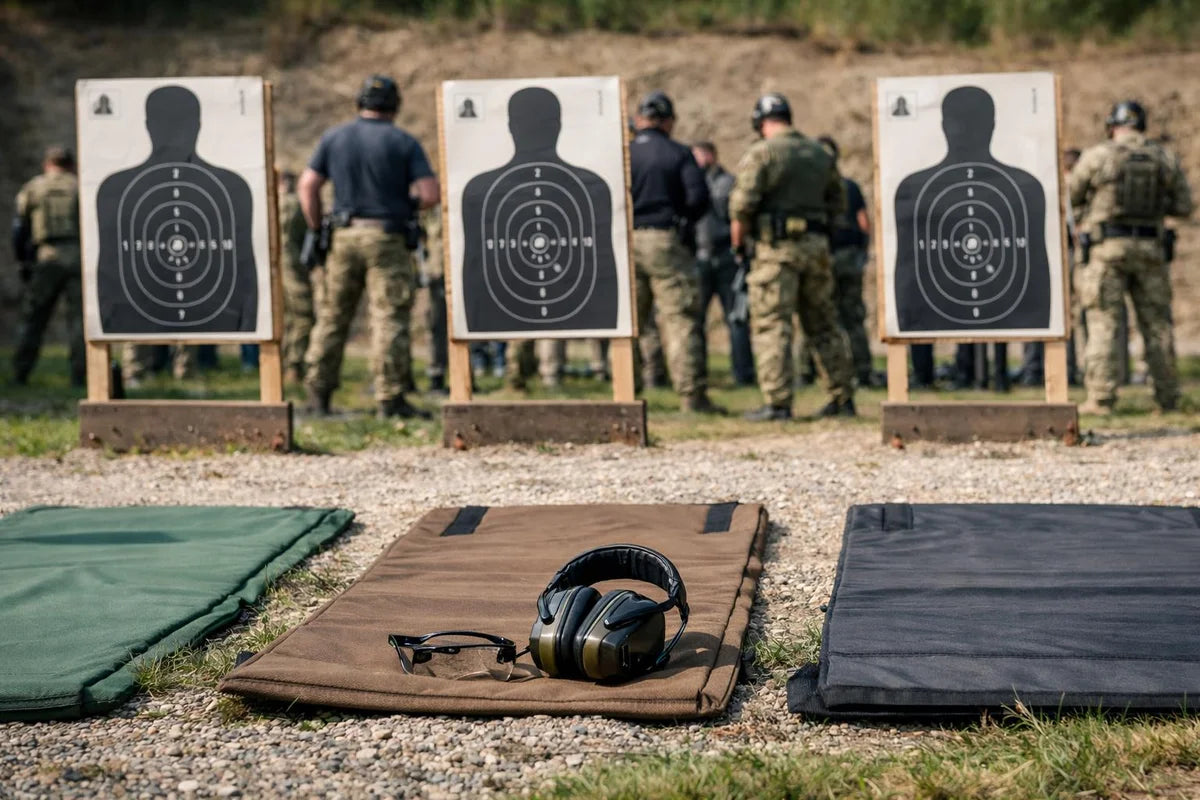
On paper, competitions look trivial: firing position, target, distance, series of shots, result. In practice, pressure, watching colleagues, limited time, emotions and the awareness that every mistake will be recorded on the target all come into play. And that is precisely why such events have value.
In the case of “Veteran’s Arrow”, the competition was not merely a sporting pastime. For some participants, it was an opportunity to take a weapon in hand again after a longer break. This matters, because shooting in the uniformed services always touches on two things at once: technique and psychology. The mechanics of the shot itself are one thing. Calm, routine and control of breathing are another.
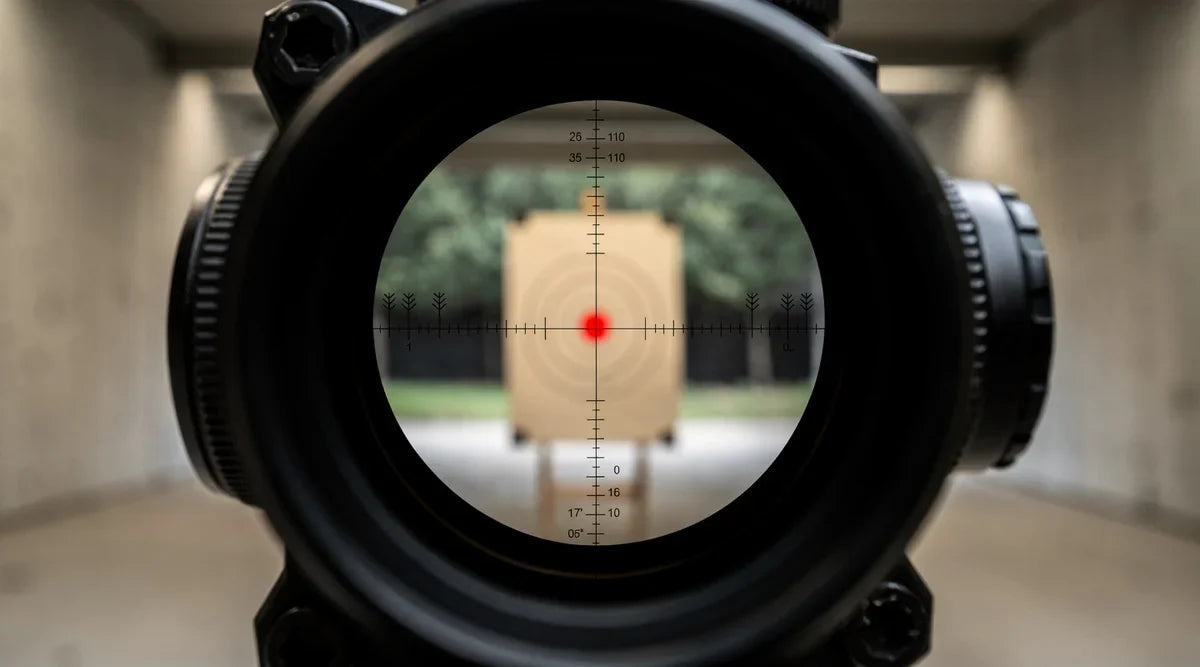
In the military and uniform-adjacent community, competition works like an honest test. No grand speeches are needed. The target shows whether the grip was repeatable, whether the sights were properly aligned and whether the competitor did not “jerk” the shot at the last moment. You cannot talk your way around that.
What does shooting competition among uniformed personnel provide?
- A comparison of skills — the result is concrete, without subjectivity.
- Contact with pressure — even in a sporting atmosphere, the pulse rises and adrenaline appears.
- A return to habits — especially important for veterans who train less often after service.
- Integration of the community — a shared competition breaks down distance faster than an official meeting at a table.
- Safe familiarity with firearms — under controlled conditions, in accordance with the rules of the event.
“Veteran’s Arrow” in Kochcice: shooting, bicycles and community
The meeting in Kochcice was organised by the Association of the Wounded and Injured in Missions Outside the Country. The association’s president, Tomasz Kloc, emphasised that such undertakings integrate a community scattered across Poland. And it is hard to disagree — veterans often live far from former colleagues from their units, and ordinary contact after years of service can loosen.
The event programme was broad. Participants went on a bicycle rally, and veterans with mobility disabilities also used electrically assisted bicycles. There was also a trip to the Historic Silver Mine in Tarnowskie Góry, a team paintball game and, of course, the shooting competition.
This combination is interesting: physical activity, an element of competition, history, remembrance and shooting. Such a format does not confine people to one role. A veteran is not just a “former soldier from a mission”. He is a father, husband, teammate, competitor on the firing line and someone who can tell younger people what service really is.
Results on the target: 10 metres, Magnum 44 and Colt 45
The shooting part of “Veteran’s Arrow” took place at a distance of 10 m. Competitors shot at the target with a Magnum 44 and a Colt 45. Participants pointed out that the two designs differ in recoil and loudness of the shot. For people who had taken a longer break from shooting, this is by no means a small detail — the reaction to recoil and noise very quickly shows whether the shooter is working calmly or fighting the weapon.
The best result was achieved by Tadeusz Królczyk: a full 100 points out of 100 possible. Second place went to Mieczysław Zymiera with 98 points, and third to Piotr Kurpas, who scored 97 points. A strong highlight was also the result of the wife of one of the veterans — 96 points. In a competition involving firearms with such a distinct character, that is a result that is hard to ignore.
| Place / result | Participant | Points |
|---|---|---|
| 1st place | Tadeusz Królczyk | 100/100 |
| 2nd place | Mieczysław Zymiera | 98/100 |
| 3rd place | Piotr Kurpas | 97/100 |
| Standout result | Wife of one of the veterans | 96/100 |
The cups were presented by Col. Marcin Suszko, commander of the Military Commando Unit from Lubliniec. His presence was not merely a courtesy. The unit and the veterans’ community share a history of service, missions and losses. The officer recalled that most JWK soldiers took part in operations outside the country between 2003 and 2023. During missions, four operators were wounded and three were killed.
State security and shooting training: this is not about sport for sport’s sake
The phrase “state security and shooting training” may sound like the topic of a conference panel, but on a shooting range it becomes very concrete. Shooting teaches responsibility, because every shot has a consequence. It also teaches humility, because even an experienced person can spoil a result through haste, tension or lack of focus.
In the case of veterans, there is one more dimension: maintaining a bond with the uniform without pretending that civilian life is a simple continuation of service. Competitions allow them to return to familiar activities, but in a safe, sporting and supportive environment. This is not a reconstruction of a mission. It is controlled competition that can provide satisfaction, test form and refresh habits.
The military treats shooting training as an element of professional preparation, while sports and integration events show that shooting can also build a community. That is why shooting competitions for uniformed services have significance beyond the classification table. Competitors see their results, organisers see the level of preparation, and observers receive a clear message: fitness does not come from declarations, but from regular practice.
Remembrance of the fallen and education: the other side of uniformed competitions
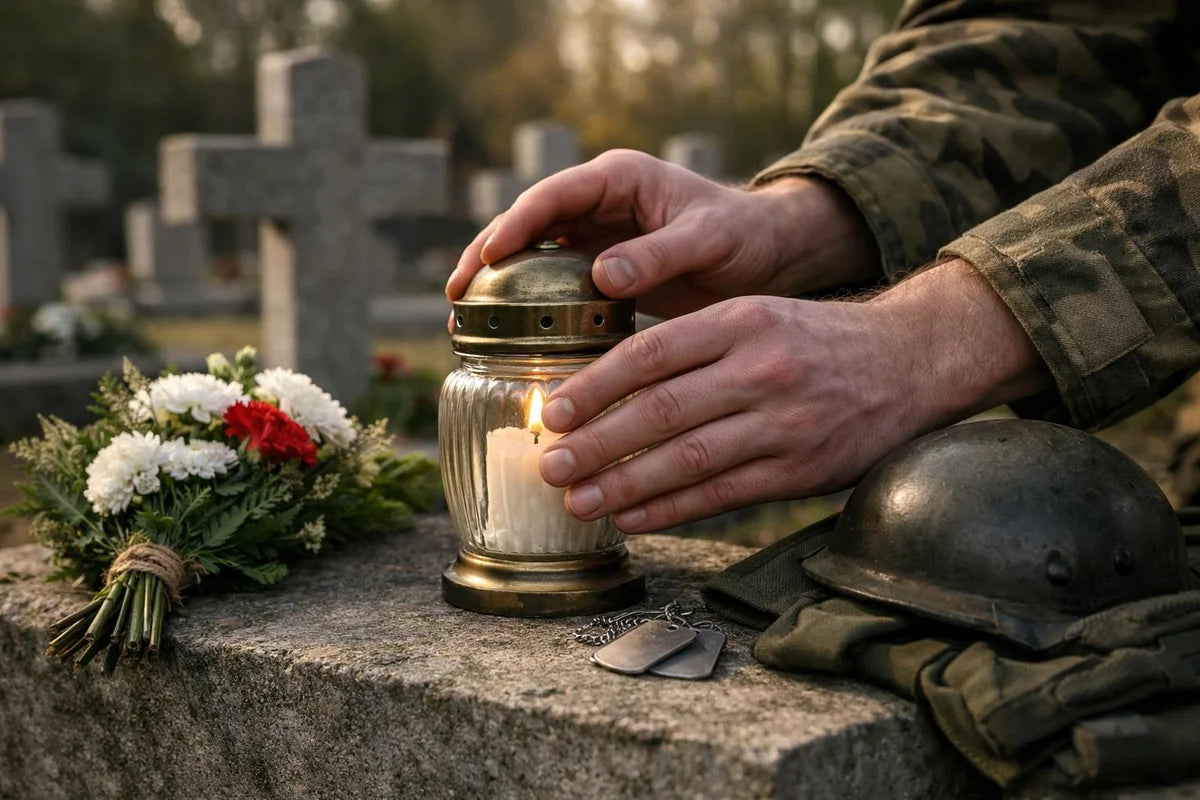
“Veteran’s Arrow” was not limited to sport. Participants laid wreaths and lit candles at the grave of Senior Staff Warrant Officer Mirosław Łucki, alias “Miron”, buried at the cemetery in Lubliniec. The association’s colour guard took part in the ceremony.
This moment clearly shows why uniformed events carry a weight that cannot be measured in points. A score of 100/100 is impressive, of course. But the memory of those who did not return, or returned wounded, sets the entire competition in the right perspective. The shooting range is then not a detached attraction. It becomes part of a larger story about service, the consequences of decisions and responsibility.
Education was also important. In the historic distillery in Kochcice, adapted into a local cultural centre and museum of technology, a lecture was given by Junior Warrant Officer (ret.) Andrzej Korus about the Tomb of the Unknown Soldier in Warsaw, in the context of the 100th anniversary of its establishment. A photographic exhibition devoted to injured veterans was presented alongside it.
The exhibition had previously reached nearby schools. According to reports, it had a quiet, reflective character and aroused the interest of pupils, especially older classes, who viewed it with a history teacher. On 11 November, the exhibition is to be shown at the Janina Garścia State Primary Music School in Lubliniec, on the occasion of a patriotic concert.
Families at the firing line: why is this important for future uniformed personnel?
Veterans’ meetings are often attended by their loved ones. There was no shortage of families in Kochcice either. This is important, because service rarely concerns just one person. Missions, injuries, separation, returns and adaptation after years — all of this affects the home.
One story shows well how a parent’s experience can turn into a choice made by the younger generation. Senior Private (ret.) Łukasz Domagalski came with his wife Agnieszka and daughter Oliwia. After turning 18, Oliwia volunteered for basic military service. She is also thinking about studying at the Military University of Technology in Warsaw and wants to become a logistician. She admits herself that she “caught” an interest in the military from her father, who served on two missions in Afghanistan.
This is not pushy promotion of the uniform. Rather, it is the natural effect of contact with people who know service from practice, not from a poster. Young people see not only the ceremony, but also the effort, consequences and community. And if, in the process, they learn that a weapon requires discipline, composure and responsibility, it is a lesson much stronger than any slogan.
And what about “Łupków Shotguns 2026”?
The phrase “Łupków Shotguns 2026” appears in the context of interest in shooting competitions and training in uniformed communities, but the source material used for this news item contains no details about that event. Therefore, we do not provide dates, a programme, organisers or disciplines — that would be adding facts, not reliable news.
However, one thing can be said honestly: the example of “Veteran’s Arrow” shows what is worth expecting from good events of this type. Not just shooting for a score, but also clear rules, a safe context, integration of the community, an educational element and respect for the people who served. If subsequent events follow this path, shooting in the uniformed services will gain ground not through an eye-catching setting, but through real value.
Conclusions: the target shows the result, but it does not show everything
The simplest thing would be to write: a competition was held, the winner scored 100 points, cups were handed out. But then the most important thing would be missed. “Veteran’s Arrow” showed that shooting competitions for uniformed services can combine fitness, remembrance, education and community solidarity.
For the military and uniformed communities, this is an important direction. Competition provides motivation. Training provides repeatability. A meeting with veterans provides perspective. And state security begins precisely with such small, concrete things: people who can act under pressure, remember the rules and understand that shooting is not a show, but a responsibility.
Frequently asked questions
What was “Veteran’s Arrow”?
It was a sports and integration meeting in Kochcice, Silesia, organised for injured veterans and their loved ones. The programme included, among other things, shooting competitions, a bicycle rally, paintball, a trip, and educational and commemorative activities.
How many participants took part in the event?
The meeting was attended by 25 injured veterans together with their loved ones.
At what distance was the competition shot?
Competitors shot at the target from a distance of 10 metres.
What weapons did the participants shoot with?
The source indicated a Magnum 44 and a Colt 45. Participants drew attention to differences in recoil and the loudness of the shot.
Who won the shooting competition?
The winner was Tadeusz Królczyk, who scored 100 points out of 100 possible. Second place went to Mieczysław Zymiera with 98 points, and third to Piotr Kurpas with 97 points.
Why does shooting competition among uniformed personnel matter?
Because it allows skills to be tested under controlled conditions, builds resistance to pressure and integrates the community. In the case of veterans, it also provides an opportunity to return to familiar habits in a safe, sporting context.
Does the source provide details of the “Łupków Shotguns 2026” event?
No. The source material described “Veteran’s Arrow”, but did not provide facts about the “Łupków Shotguns 2026” event, which is why the article does not add its programme, dates or organisers.
How did the event combine shooting with remembrance of the fallen?
Participants laid wreaths and lit candles at the grave of Senior Staff Warrant Officer Mirosław Łucki, alias “Miron”, in Lubliniec. The programme also included an exhibition about injured veterans and a lecture about the Tomb of the Unknown Soldier in Warsaw.