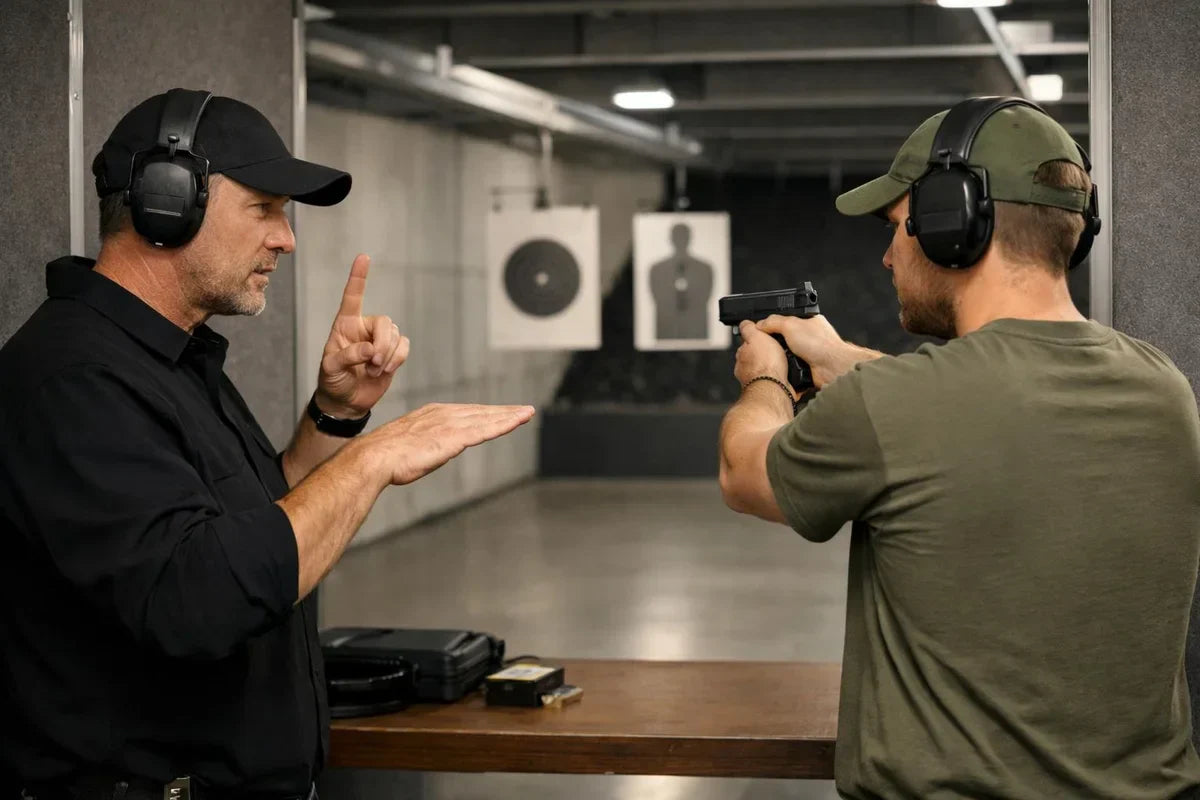
Poles want to feel safe — firearms appear in this conversation not only as an object, but also as a symbol of control over one’s own life. For some, they are a “last resort” and a psychological safety policy. For others — a tool that provides an illusory sense of comfort, because in a real conflict it can raise the stakes faster than anyone has time to cool down.
The spark for the next round of this discussion was a conversation on TOK FM on May 26, 2026. Andrzej Idzikowski, a former police officer from the Police Training Center in Legionowo, a trainer and shooting instructor, spoke plainly there: a firearm is a “last-resort measure,” and simply entering the world of permits, regulations and responsibility often… cools emotions.
This is an interesting center of gravity, because the debate about firearms in Poland usually gets stuck in the slogan: “more firearms = more safety” versus “more firearms = more risk.” Meanwhile, the instructor’s statement reveals a third layer: firearms can increase a sense of agency, but at the same time they force greater restraint. And this is exactly where things get most interesting.
Firearms and the sense of security: does the mere fact of owning one change anything?
The simplest answer is: it can change things, but not always in the way a person imagines before obtaining a permit. Andrzej Idzikowski’s comments suggest that many people, after going through the process of obtaining a permit, begin to look at firearms differently. Not as a magic “safe” button, but as a tool burdened with responsibility, risk and consequences.
This matters because the phrase firearm ownership safety is often treated like a simple equation. I have a firearm, so I feel more confident. Except real life rarely works like an internet graphic. In a tense situation, stress, uncertainty, the other person’s behavior and very limited time to make a decision all come into play.
Idzikowski pointed out that people who own firearms often “cool down.” In practice, this means less willingness to get into random disputes, less grappling in road conflicts, less proving anything to anyone. Because if you are aware that you are carrying a tool with such serious consequences, then a stupid shouting match suddenly stops being “just a shouting match.”
That is the paradox of the debate: a firearm can provide a sense of protection, but a mature user should not become bolder in conflicts because of it. They should become more cautious.
A firearm as a safety policy: why does this argument work so strongly?
The term a firearm as a safety policy describes the psychological mechanism well. No one buys insurance policies in order to use them every day either. People buy them in case of an extreme situation. Some people look at firearms in a similar way: hopefully they will never be needed, but if things ever get really bad, it is better to have a tool than not to have one.
This argument has emotional force because it touches on a basic need: “I want to have at least minimal influence over what happens to me and my loved ones.” And here supporters of broader access to firearms usually feel that they are talking about responsibility, not aggression.
The problem is that an insurance policy does not escalate a conflict. A firearm — can. Merely displaying it does not necessarily end the threat. Idzikowski emphasized that we do not know how an attacker will react to the sight of a firearm. They may back off. They may get scared. But they may also be determined and not be stopped by the mere sight of the object.
The biggest trap: “I’ll draw it and the problem will disappear”
This is exactly where opinions diverge. One side assumes that owning a firearm provides a psychological advantage. The other replies: a psychological advantage exists only if the other person reacts predictably. And that assumption can be very fragile.
The TOK FM instructor also pointed to one more element: in Poland, firearm replicas are very similar to real firearms. For an aggressor, the sight of an object does not have to be unambiguous. They may not know exactly what they are seeing. They may decide it is a replica. They may not have time to assess it. They may react chaotically.
This is not an argument against every firearm owner. It is an argument against the fairy-tale scenario in which the mere appearance of a firearm solves the problem like a TV remote.
“These people cool down”: responsibility instead of fantasies of heroism
The strongest part of this media debate is not about firearms themselves, but about a change in attitude. According to Idzikowski, people who learn the rules for using firearms in Poland and understand what they really are often withdraw from unnecessary tensions.
That sounds less spectacular than internet debates, but it is much closer to a responsible approach. A mature firearm owner does not look for opportunities to “be right.” They do not raise the stakes in traffic. They do not test who can shout louder outside a shop. They do not enter a conflict just because they have an ultimate tool with them.
If firearms are supposed to increase a sense of security, it is not by adding a “Rambo” mode to one’s character. Rather, it is through the awareness: “I have responsibility, so I do not add fuel to the fire.”
- Less impulsiveness — because the consequences of a wrong decision can be dramatic.
- More distance — a random provocation is not worth the risk.
- More humility — a firearm does not automatically solve a crisis situation.
- More listening to instructors — because on the shooting range, ego can be a worse adviser than lack of experience.
Access to firearms in Poland — opinions collide over the question: whom do we trust?
The phrase access to firearms in Poland opinions shows well that this discussion is not purely technical. It is social. It is about trust: in citizens, in procedures, in instructors, in the law, and in one’s own assessment of a situation.
A supporter will say: a responsible person, after training and obtaining a permit, does not become a threat, but a more aware citizen. A skeptic will respond: even a responsible person may find themselves in a situation where stress, adrenaline and a mistaken assessment take over.
Idzikowski’s statements make it possible to step out of this barren trench war. Because he does not present firearms as toys or as demons. He talks about them like a practitioner: they are tools that require strong justification if someone is to draw them. And tools that are reached for only when a person is aware of the possible consequences.
In a shop, club or at a shooting range, it is worth talking about this without sugarcoating it. Accessories, equipment organization, training and safety only make sense when the user understands the foundation: firearms are not for boosting self-confidence in everyday clashes. If you are interested in the broader context of everyday carry, also see our commentary: Carrying firearms in Poland: pros and cons.
Women at the shooting range: less ego, more listening
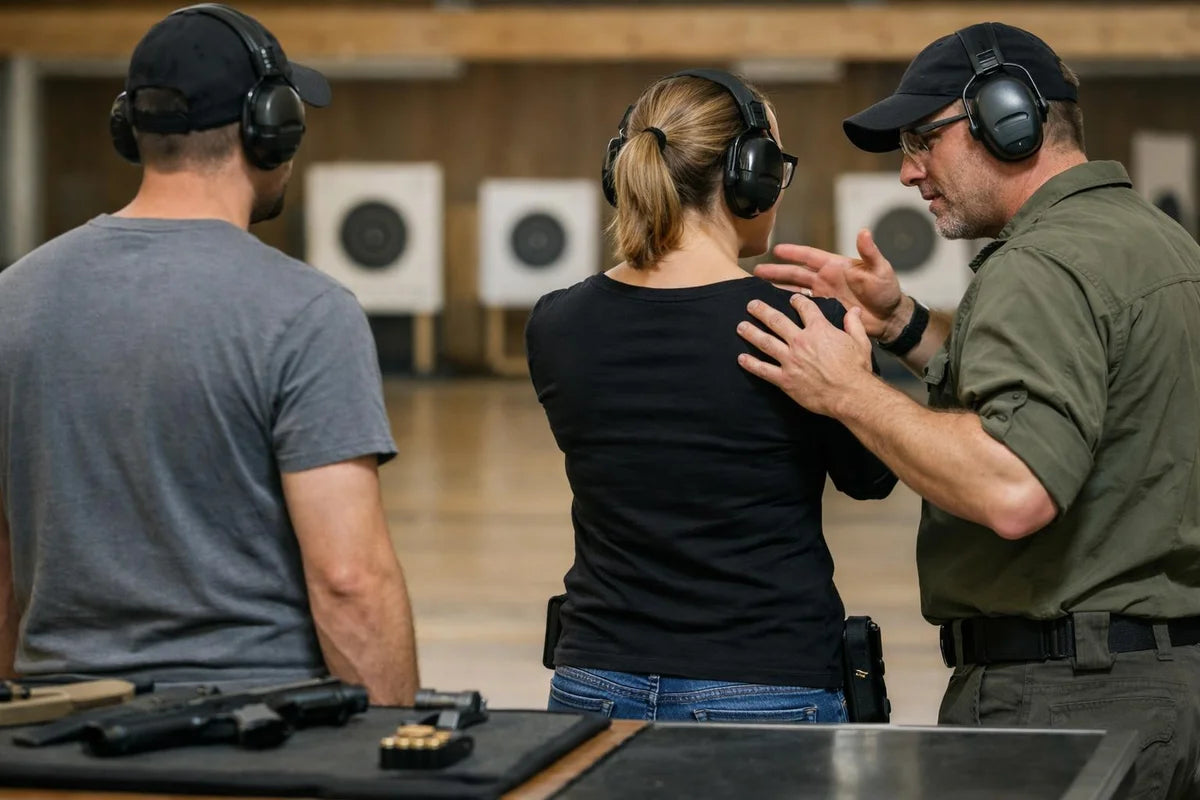
The conversation also included a topic that will bring a “we know this one” kind of smile to many shooting ranges. Idzikowski noted that women during shooting training are often more precise than men. His explanation is simple: they listen to the instructor and reproduce what they have heard more accurately.
The contrast is men who are convinced they were “born with a firearm included.” Every instructor knows this type of trainee: he has not even gripped it correctly yet, and he already knows better. Then comes the series, the target tells the truth, and suddenly it turns out that the partner who came “just to try” is doing a better job.
This passage is more important than it looks. It shows that safety does not begin with the permit itself or with buying equipment. It begins with attitude. A person who can listen learns safe habits faster. A person who knows everything in advance usually first has to lose to their own ego.
Owning firearms and safety: arguments from both sides without shouting
If we gather this debate in one place, two reasonable sets of arguments are visible. There is no need to immediately turn one side into cowboys and the other into people detached from reality. The dispute is more serious than that.
The argument of the “firearms increase the sense of security” side
A person who owns a firearm may feel that they are not completely helpless in an extreme situation. This sense of agency has psychological significance. In addition, the path through training, regulations and practice can strengthen responsibility rather than bravado — precisely the “cooling down” effect described by Idzikowski.
The skeptical side’s argument
Skeptics ask: what happens in a real conflict when a firearm is shown? Will the aggressor back off, or on the contrary — react more violently? Does the person with the firearm really have full control over the situation, if the other side may not know whether they are seeing a firearm, a replica or something similar?
The common denominator
Both sides can agree on at least one thing: a firearm is not a gadget for improving one’s mood. If it is to be an element of safety, it must go hand in hand with a cool head. Without that, it becomes not a policy, but a risk written in fine print.
What is this debate really saying?
The phrase firearms and the sense of security does not have one simple answer. A firearm can provide a sense of protection, but it should not provide a sense of impunity, an advantage in everyday arguments, or the right to escalate tension.
The most interesting conclusion from the TOK FM conversation is this: responsibly entering the world of firearms often does not heat people up, but cools them down. A person begins to weigh their words, avoid unnecessary clashes and understand that a firearm is a last-resort tool, not an argument in a discussion.
And perhaps this is precisely how the debate about firearms in Poland should be conducted: fewer slogans, more conversation about responsibility. Because if Poles want to feel safe, firearms alone are not enough. What is also needed is humility toward what they are.
Frequently asked questions
Does owning a firearm really increase the sense of security?
It can increase a sense of agency, but according to Andrzej Idzikowski’s comments, many people become more restrained after learning the rules and responsibilities connected with firearms. It is not always “more courage”; more often it is “more caution.”
What does the term “a firearm as a safety policy” mean?
It is a way of thinking in which a firearm is meant to be a tool for an extreme situation, hopefully never used. The problem is that merely owning a firearm does not guarantee a simple resolution of a conflict.
Why does the instructor say that firearm owners “cool down”?
It is about a change in attitude after learning the realities of using firearms. People aware of the consequences are less likely to get involved in random disputes, road conflicts or situations that may escalate unnecessarily.
Does showing a firearm always deter an aggressor?
No. Idzikowski pointed out that it is impossible to predict an aggressor’s reaction in advance. A determined person may not be stopped by the mere sight of a firearm.
Why are firearm replicas important in this discussion?
The conversation pointed out that replicas can be very similar to real firearms. This complicates the situation, because the other side may not know exactly what they are seeing and how to assess it.
Should a firearm be treated as the first-choice measure?
No. In Andrzej Idzikowski’s statement, a firearm was described as a last-resort measure. Reaching for it requires awareness of the consequences and very serious justification.
Do women really perform better at the shooting range?
According to Idzikowski’s observations, women during training are often more precise because they listen more carefully to the instructor and follow instructions more accurately. He also noted that men more often start with excessive self-confidence.
What is the most important conclusion from the debate about firearms in Poland?
A firearm can be an element of the sense of security, but only with a responsible approach. It does not replace a cool head, avoiding escalation and the awareness that it is a last-resort tool.