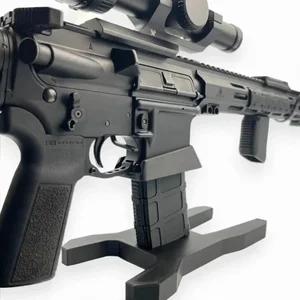
GROTowisko once again did what sounds simple in theory but can be difficult in practice: it brought soldiers, instructors, experts, and designers to one table. The sixth edition of the event took place in Zegrze and Marynin, and its central focus was the GROT A3 — the latest version of the carbine from the MSBS GROT family.
This was not an ordinary equipment showcase “for photos.” In the background of the event were two concrete pieces of information: the acceptance of the MSBS GROT A3 technical documentation by the Armament Agency and the contract signed on June 23 for the delivery of nearly 46,000 MSBS GROT C14 A3 carbines for the Polish Armed Forces. In short: the Polish weapon has passed another formal stage and is entering military service on a large scale.
The most interesting thing, however, is not the contract itself, but the mechanism behind the modernization. GROTowisko shows a model in which soldiers test the weapon, report operational feedback, and Fabryka Broni turns those observations into successive versions of the design. Without any marketing fog: this is about a feedback loop between the user and the manufacturer.
GROTowisko 2026: what exactly happened?
The sixth edition of GROTowisko took place in two locations: at the Club of the Communications and Information Technology Training Center in Zegrze and at the Bellona shooting range in Marynin. The organizers were the Territorial Defence Forces Command and Fabryka Broni “Łucznik” – Radom sp. z o.o.
The event had a two-part format. The first day was expert-focused: a conference, discussions about operation, development directions, and user training. The second day shifted the emphasis to practice, namely shooting competitions using Fabryka Broni equipment.
This matters because, in the case of small arms for the Polish Armed Forces, a slide presentation alone is never enough. A carbine has to work in the hands of the people who carry it, clean it, train with it, and use it under pressure. If a comment appears only after thousands of repetitions during training or competition, that is exactly the kind of feedback that can be most valuable.
Why was the GROT A3 the most important point of the event?
The GROT A3 was at the center of GROTowisko for a reason. Several days before the event, the Armament Agency accepted the technical documentation for the latest version of the MSBS GROT A3 carbine. According to the announcement, this meant the formal closure of another stage in the design’s development and opened the way for its implementation in the Polish Armed Forces.
This was followed by the June 23 contract between the Armament Agency and Fabryka Broni “Łucznik” – Radom sp. z o.o. Its subject is the delivery of nearly 46,000 MSBS GROT C14 A3 carbines for the Polish Armed Forces. For small arms, this is no longer a display-case curiosity, but a serious volume for the army.
It is worth being precise: the available announcement does not list specific technical changes in the A3 version. So there is no point guessing what exactly was improved, moved, reinforced, or redesigned. What is certain, however, is that weapon modernization within the MSBS GROT family is presented as the result of many years of cooperation between the manufacturer and military users.
The feedback loop: the soldier speaks, the designer listens
The greatest value of GROTowisko lies in the fact that it connects two worlds that must understand each other: users and the manufacturer. A soldier sees a weapon through the lens of training, handling, operating tempo, and the everyday question of “does this get in my way, or does it help me?” A designer looks at the solution technically: material, geometry, production, repeatability, documentation.
If these worlds do not talk, a classic problem emerges: equipment may look good in a catalog but stumble in practice. GROTowisko tries to shorten that distance. Operational comments, instructors’ observations, and experience from successive editions of the event feed into discussions about the further development of the MSBS GROT family.
During the conference, the topics discussed included:
- operational experience with MSBS GROT carbines,
- directions for further development of the GROT family,
- changes in the user training process,
- Fabryka Broni’s plans regarding its offer for uniformed services,
- further variants of the MPS Modular Semi-Automatic Pistol.
The announcement also included information about planned familiarization tests of the MPS pistol in the Polish Armed Forces. This shows that Fabryka Broni is not limiting the discussion to one system. The GROT family is currently the most visible, but the dialogue with users also covers other designs.
Military tests do not always look like a laboratory — and that is a good thing
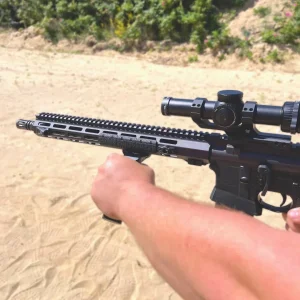
The second day of GROTowisko took place at the Bellona shooting range in Marynin. There, the conference language turned into something more concrete: time, accuracy, procedures, control, and teamwork.
Several Fabryka Broni designs were used in the competition: the VIS 100 pistol, the MSBS GROT C16-A2 carbine, the MSBS GROT grenade launcher, and the MSBS GROT 762N rifle. So it was not a demonstration of a single firearm, but a practical overview of various elements of the manufacturer’s offer.
The competition was opened by: Secretary of State at the Ministry of National Defence Magdalena Sobkowiak-Czarnecka, Commander of the Territorial Defence Forces Maj. Gen. Dr. Krzysztof Stańczyk, and President of the Management Board of Fabryka Broni “Łucznik” – Radom sp. z o.o. Seweryn Figurski. Undersecretary of State at the Ministry of State Assets Konrad Gołota also took part in the event.
The conditions were difficult because the competition took place on the hottest day of the year. The organizers provided water, rest areas, and water curtains. Sounds like a detail? On a shooting range, such a “detail” can determine whether an event maintains a professional rhythm or turns into a fight against dehydration and a drop in concentration.
What do the competitions say about the development of Polish weapons?
Shooting competitions do not replace full tests, documentation, or implementation procedures. But they provide something you cannot get from a spreadsheet alone: observation of the weapon in the hands of trained users, under time pressure and in dynamic competition.
In practice, this reveals things that are difficult to catch during a calm, one-off check. How does the user operate the controls? Does the configuration help with fast action? Is handling intuitive when tired? Does the equipment avoid forcing unnecessary movements? The source does not provide detailed technical conclusions, so there is no point adding any. The format of the event itself, however, shows the point: military tests and practical shooting are among the impulses for further refinement of the design.
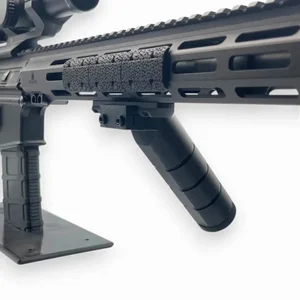
This is also a good lesson for the civilian and sporting market. A shooter can discuss parameters for hours, but only training on the firing line shows whether a given solution fits real work with a weapon. This applies both to military designs and to accessories that affect ergonomics, for example items from the foregrips and weapon control category. Of course, the military scale is different, but the principle remains the same: equipment must prove itself in use.
The best competitors of GROTowisko-26
The source announcement also provided the results of the competition. This is an interesting part because it shows that GROTowisko was not only a defense industry forum, but also a place for sporting confrontation among soldiers from different units.
Carbine shooting
- Cpl. Mateusz — 1st Podlaska Territorial Defence Brigade,
- Senior Pvt. Maciej — 13th Silesian Territorial Defence Brigade,
- Senior Pvt. Oskar — 12th Greater Poland Territorial Defence Brigade.
Military pistol shooting
- Senior Cpl. Hubert — Military University of Technology,
- Senior Cpl. Kacper — 6th Mazovian Territorial Defence Brigade,
- Sgt. Konrad — Military Unit 4621.
Carbine and military pistol shooting
- Sgt. Daniel — 5th Mazovian Territorial Defence Brigade,
- Lt. Jacek — 25th Air Cavalry Brigade,
- Sgt. Mateusz — 2nd Lublin Territorial Defence Brigade.
Team and overall classifications
In the team classification, the top places were taken by: the 11th Małopolska Territorial Defence Brigade, the 4th Warmian-Masurian Territorial Defence Brigade, and the 18th Capital Territorial Defence Brigade.
In the overall classification, the following were indicated: the 2nd Lublin Territorial Defence Brigade, the 11th Małopolska Territorial Defence Brigade, and Military Unit 4621.
Fabryka Broni and the Polish Armed Forces: why does this model matter?
In the Polish defense industry, it is very easy to fall into two extremes. One says: “it is ours, so it is excellent.” The other says: “it is Polish, so it is certainly worse.” Both are lazy. In the case of small arms, what matters is not declarations, but the process: implementation, operation, corrections, successive versions, training, and the next round of feedback.
GROTowisko is an example of such a process. Fabryka Broni gets direct contact with users, and soldiers have a place where their experiences do not remain merely a conversation while cleaning weapons after shooting. They enter a broader discussion about design and training.
This is especially important when we are talking about a system that is to reach the army in large numbers. Nearly 46,000 MSBS GROT C14 A3 carbines means that every good design decision will be repeated thousands of times. But it also works the other way: every inconvenience, if not caught, will also be repeated. That is why the feedback loop is not a nice extra. It is a condition for the design to mature.
From a shooter’s perspective, one more thing is worth noting: a modern weapon is not just the mechanism itself. It is an entire ecosystem of use — training, handling, safety, organization of the position, and repeatability of procedures. That is why, in clubs and at shooting ranges, sensibly selected shooting station equipment matters so much. In the military, the scale is different, but the logic of working on the firing line remains very similar.
GROT A3 as a signal: Polish weapons are to develop iteratively
The most important conclusion from GROTowisko is not: “here is the finished ideal.” Rather, it is: the GROT system is being developed in stages, with user participation. And that is precisely a healthy approach.
The acceptance of the A3 technical documentation, the large contract for the Polish Armed Forces, and the competition in Marynin form one story. First come experience and discussions, then the formalization of the next version, followed by implementation and further practice. This is what the maturation of a design looks like when it is meant to serve not at an exhibition, but in the hands of soldiers.
For Fabryka Broni, this is also a message to the market: the manufacturer is showing that it wants to base development on contact with the user, not only on work behind closed doors. For the Polish Armed Forces, in turn, it is a chance for small arms to be adapted to real training and service needs.
GROTowisko under the banner of the GROT A3 was therefore not merely an industry meeting. It was a moment that clearly showed how the defense industry, the military, and practical tests can meet at one point. And if a better design comes out of that firing line, then that is exactly what this is all about.
Frequently asked questions
What was GROTowisko?
GROTowisko is a forum for exchanging experience between Fabryka Broni “Łucznik” – Radom and soldiers, instructors, and experts using Polish armaments. The sixth edition took place in Zegrze and Marynin.
Why was this year’s GROTowisko connected with the GROT A3?
The event coincided with the Armament Agency’s acceptance of the technical documentation for the latest MSBS GROT A3 version and with a contract for the delivery of nearly 46,000 MSBS GROT C14 A3 carbines for the Polish Armed Forces.
Who organized GROTowisko?
The event was organized by the Territorial Defence Forces Command in cooperation with Fabryka Broni “Łucznik” – Radom sp. z o.o.
What role do soldiers play in the development of the GROT carbine?
Soldiers provide experience from operation, training, and practical use of the weapon. These comments are discussed with the manufacturer and form part of the development process for successive versions of the design.
Which designs were used during the competition in Marynin?
Fabryka Broni equipment was used during the competition, including the VIS 100 pistol, the MSBS GROT C16-A2 carbine, the MSBS GROT grenade launcher, and the MSBS GROT 762N rifle.
Does the source provide specific technical changes in the GROT A3 version?
No. The available material points to the acceptance of the technical documentation and the development of the design based on cooperation with users, but it does not list detailed technical changes in the A3 version.
What were the conditions during the competition?
The competition took place on the hottest day of the year. The organizers provided water, rest areas, and water curtains to ensure the safety of participants.
How many MSBS GROT C14 A3 carbines are to be delivered to the Polish Armed Forces?
The contract signed on June 23 provides for the delivery of nearly 46,000 MSBS GROT C14 A3 carbines for the Polish Armed Forces.