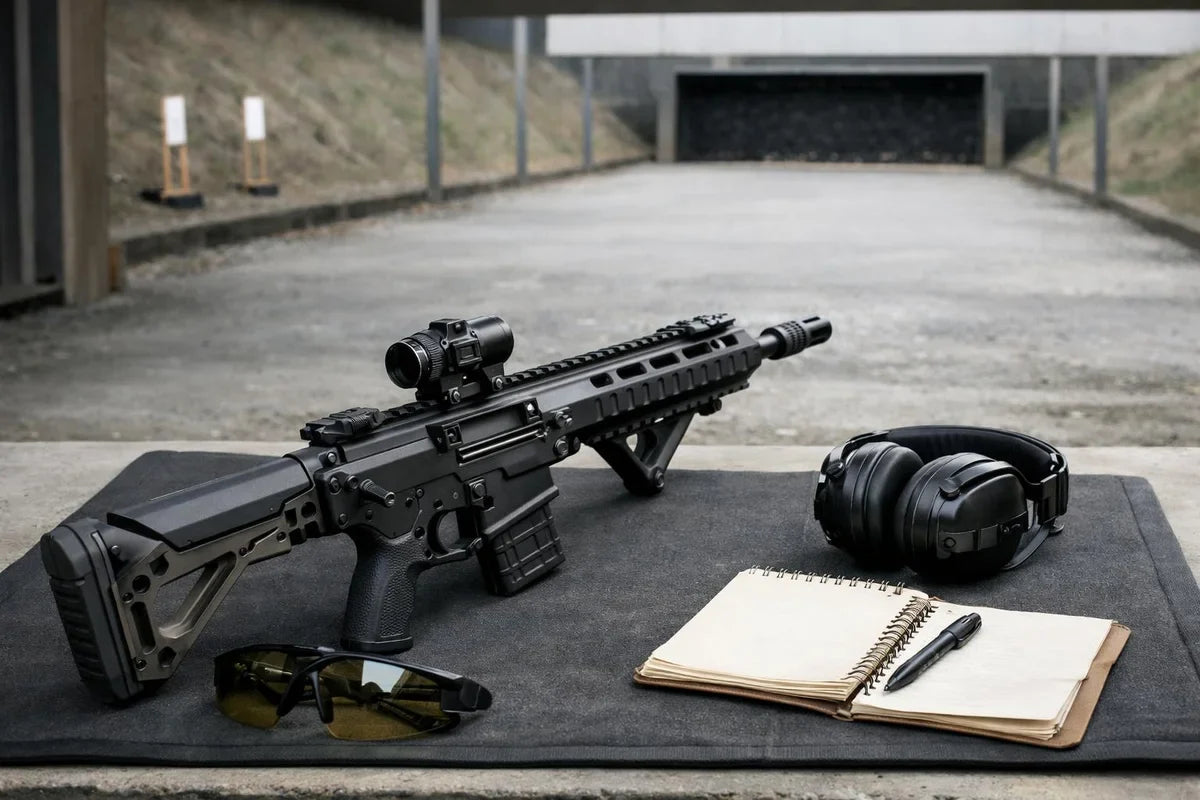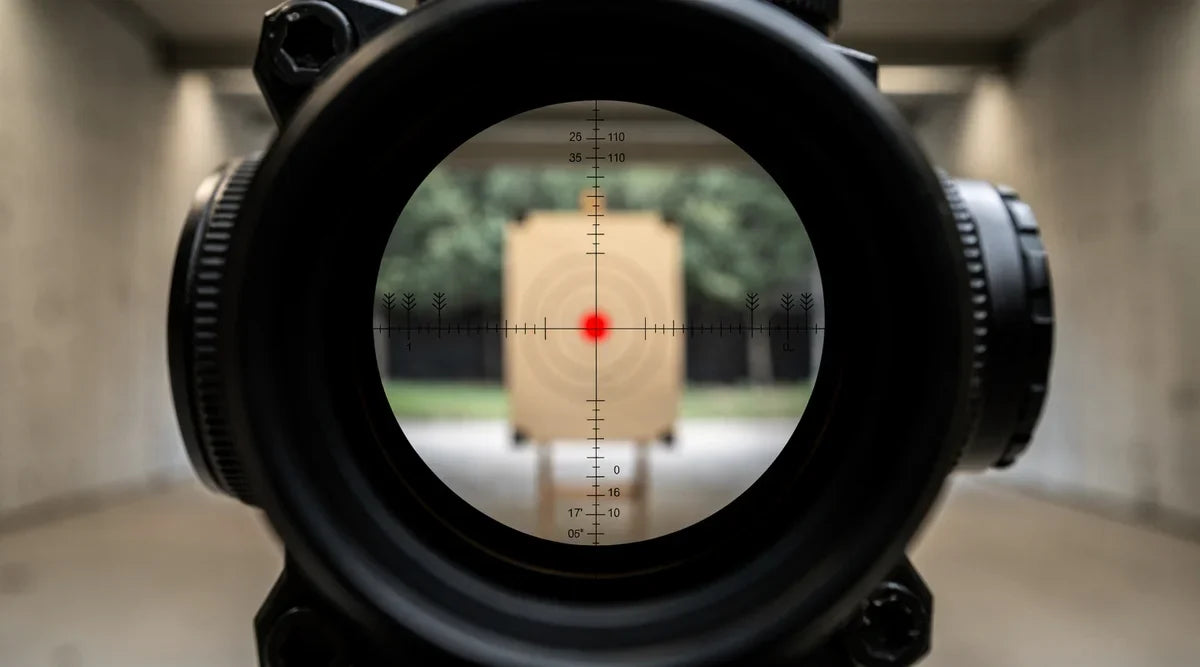
An LPVO scope is designed to combine the speed of a red dot sight at the lowest magnification with more precise aiming at longer distances. That is why it is so often fitted to rifles used recreationally, in sport shooting, dynamic shooting, and hunting. However, there is no single model that is right for everyone. A 1-6x LPVO can be an excellent first scope, while a 1-10x can be both highly versatile and too demanding for some users.
When buying, do not start with maximum magnification or the brand alone. First, determine the distances at which you actually shoot, your pace of use, lighting conditions, and a budget that also includes a solid mount and lens protection. Only then should you compare specific optics, their reticles, adjustments, and ergonomics.
If you first want to organize the basic concepts, the article LPVO – what it is and how it differs from a red dot sight and a traditional scope will be useful. Below, you will find a practical selection checklist without marketing shortcuts.
What does LPVO mean, and who does this type of scope make sense for?
The abbreviation LPVO comes from the English term Low Power Variable Optic, meaning a scope with low, variable magnification. A typical range starts at 1x and ends at 4x, 6x, 8x, or 10x. At 1x, the image should allow quick target acquisition with both eyes open, although the feeling of a “true 1x” depends on the design, diopter adjustment, and individual eyesight.
It is a good type of optic when you have close and distant targets within the same shooting session, or when the distance is not fixed. At the lowest magnification, the priority is a wide field of view and quickly finding the aiming point. Once you increase magnification, you gain the ability to assess the target more precisely and use the reticle markings.
An LPVO is not automatically the best choice for every role. A lightweight red dot sight will usually be faster at very short distances, while a traditional higher-magnification scope will be better when the main focus is calm, precise shooting at long ranges. An LPVO wins through compromise, not magic.
How to choose a magnification range: 1-4x, 1-6x, 1-8x, or 1-10x?
The most important rule is simple: choose the range for your primary use, not for the longest distance that happens once a year. More zoom may be useful on paper, but it often means more weight, a more demanding image at maximum magnification, a narrower field of view, and a higher price.
1-4x and 1-6x LPVOs: a practical starting point
The 1-4x range still makes sense in a lightweight, simple setup used mainly at shorter distances. For many people, a 1-6x model is the most versatile starting point. It provides a reasonable magnification reserve while usually remaining easier to master than designs with a greater magnification range.
1-8x LPVOs: more detail, more demands
A 1-8x is worth considering if you often use more distant targets and can accept the compromises. Before buying, make sure to check the image at 8x, not just the impressive 1x view in the store. Look at edge sharpness, brightness, eye placement comfort, and whether the magnification ring moves smoothly but with noticeable resistance.
1-10x LPVOs: do not buy solely for the number
A 1-10x range offers great capabilities, but it requires good build quality for the image at the high end of the range to remain usable. Such a scope is also usually larger and heavier. If most of your training takes place at short distances, you probably will not use the full potential of 10x, but you will carry its price and weight.
How to read scope markings, for example 1-6x24?
The 1-6x24 marking indicates a magnification range from 1x to 6x and an objective lens diameter of 24 mm. In LPVO scopes, 24 mm is very popular because it allows for a compact form factor. However, the objective diameter alone does not tell you everything about image brightness. Glass quality, optical coatings, design, and exit pupil diameter are equally important.
The exit pupil can be estimated by dividing the objective diameter by the current magnification. In a 1-6x24 scope, it is approximately 24 mm at 1x and 4 mm at 6x. This shows why eye placement becomes less forgiving as magnification increases.
When inspecting a scope, pay attention to:
- field of view at 1x, because it affects observation speed;
- eye relief, meaning the distance from the eyepiece required for a full image;
- eye box, meaning eye position tolerance, especially important when moving;
- diopter adjustment, which sets reticle sharpness for your eyesight;
- the magnification ring, which should be easy to operate securely without accidental adjustment.
MOA or MRAD: which reticle and click value should you choose?
MOA and MRAD are two angular systems used to describe reticle markings and turret adjustments. Neither is inherently more accurate. The key is consistency: it is most convenient when reticle markings and click values are described in the same system. Then you can observe the deviation on the reticle and correct it without converting units.
MOA is widely used, especially in American optics. MRAD, often casually called mil, is a decimal system and can be intuitive for people used to metric measurements. In practice, learn one system, remember the click value in your scope, and read the manual for the specific model. Do not assume every turret has the same adjustment value.
BDC reticles, illumination, and first or second focal plane
A BDC reticle can speed up your work, but its markings are usually linked to specific assumptions about ammunition and conditions. Treat them as a reference point that must be verified at the range, not as a universal calculator. A “Christmas tree” reticle provides more reference points for corrections, but it can be less clear on fast targets.
Second focal plane, SFP, is popular in LPVO scopes, where the apparent reticle size does not change with magnification. First focal plane, FFP, maintains reticle scale accuracy across different magnifications, but fine reticle elements may be less visible at 1x. An illuminated dot or central aiming mark genuinely helps in bright daylight, provided the illumination is sufficiently intense and easy to adjust.
Parallax in LPVO scopes: is a fixed setting enough?
In many LPVO scopes, parallax is factory-set at a specific distance, with no separate adjustment knob. This is normal for this class of optics and simplifies operation. However, do not confuse parallax adjustment with the diopter ring. You set the diopter so that the reticle is sharp for your eye, while parallax concerns the apparent shift of the reticle in relation to the target when your eye is not perfectly aligned with the optical axis.
At the lowest magnifications, the impact of the error is usually less troublesome, but it increases with magnification and distance. Therefore, the foundation remains a consistent shooting position, proper mount height, and a full field of view without black crescents at the edges of the image.
Mounting an LPVO: position first, tightening second
Even a very good scope will not perform well on a poorly selected or incorrectly set mount. A one-piece mount is often chosen for LPVO scopes because it makes it easier to maintain ring alignment and position the scope on the rifle. However, this does not mean every one-piece mount will be suitable for every configuration.
Match the ring diameter to the scope tube and choose a height that gives you a natural shooting position without raising your head and without the optic touching the firearm. Before final tightening, set the magnification to maximum, assume your normal shooting position, and move the scope forward or backward until you obtain a full image. Then level the reticle in relation to the firearm.
Always take torque values from the scope and mount manufacturer instructions. Excessive force can damage the tube, while too little can lead to shifting. Do not tighten by feel if you have access to a suitable torque wrench. You can read more about selecting equipment in the Optics section.
Protecting your scope during transport and at the range
A dirty lens, an accidental impact against equipment, or a cap lost in a bag are all part of using optics. Good lenses do not like sand, dust, or accidental contact with hard objects. Instead of cleaning a lens with your sleeve, first remove loose dust with an air blower or optics brush, then use a clean cloth intended for lenses.
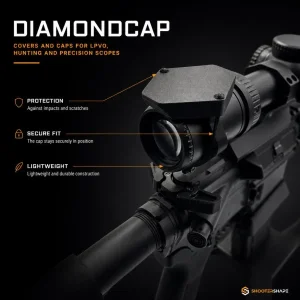
For transport and storage, covers matched to the specific scope are a sensible addition. DiamondCap – fitted covers and caps for scopes is a system for LPVO, hunting, and precision scopes. You can choose a front cover, rear cover, or a complete set. The caps are connected to the ring with shock cord, so they remain secured both when closed and when open.
When choosing this type of protection, the exact scope model matters. For verified profiles, dimensions are filled in automatically, while for a profile awaiting measurement, you need to provide the external housing diameters according to the diagram on the product page. This is important because a cover that “more or less fits” often fails precisely when the equipment is being carried.
The most common mistakes when choosing an LPVO scope
- Buying the highest magnification without checking the image. A 10x figure looks good in the specifications, but it does not replace image quality and ergonomics.
- Leaving the mount out of the budget. The scope, mount, and correct setup form one system.
- Mixing MOA and MRAD. It is possible to work with this setup, but it unnecessarily slows corrections and increases the risk of mistakes.
- Evaluating a scope only in the store. Check the optic in bright light, under cover, and at maximum magnification as well.
- Setting the diopter based on the target image. The diopter is used to sharpen the reticle, not the landscape behind it.
- No lens protection. A scratch or dried dirt can quickly ruin the comfort of using even very good optics.
A short checklist before buying
Finally, answer five questions: at what distances do I shoot most often, do I need more speed or target detail identification, which unit system do I already know, does my budget include a mount, and can I inspect the scope at different magnifications? If the answers are specific, the choice stops being a lottery.
A good LPVO does not need the longest list of features. It should provide a clear image, predictable adjustment, a comfortable shooting position, and a reticle you understand how to use without having to think about it during training.
Frequently asked questions
Is a 1-6x LPVO sufficient for sport shooting?
For many users, yes. A 1-6x range combines fast use at close distances with the ability to aim more precisely at longer ranges. The final choice depends on the discipline, target sizes, and distances at which you actually train.
Is it better to choose an MOA or MRAD reticle?
Choose a system that is consistent between the reticle and turret clicks, and that you intend to use consistently. MOA and MRAD are angular units, and ease of use depends primarily on familiarity with the selected system.
Does every LPVO scope have parallax adjustment?
No. Many LPVO scopes have factory-set parallax and do not offer a separate adjustment knob. This is typical for optics designed for faster shooting at low and medium magnifications.
What do SFP and FFP mean in an LPVO scope?
SFP means a second focal plane reticle, whose apparent size does not change with magnification. In FFP, the reticle changes size together with the image, so its markings remain proportional at different magnifications.
How do I set the diopter on a scope?
Set the diopter adjustment so that the reticle itself is sharp for your eye. It is not intended to set the focus of a distant target.
Does an LPVO need a one-piece mount?
It is not the only option, but it is a common and practical solution for rifles. The most important factors are compatibility of the diameter with the tube, the proper height, and correct scope positioning in relation to the eye.
How do I choose DiamondCap covers for a scope?
Select the type, manufacturer, and exact model of your optic. For verified profiles, dimensions are filled in automatically. If the profile requires measurement, provide the external housing diameters according to the diagram on the product page.